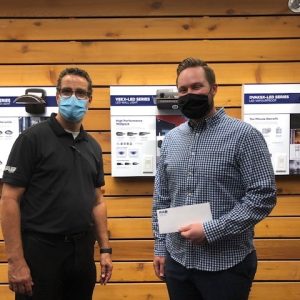
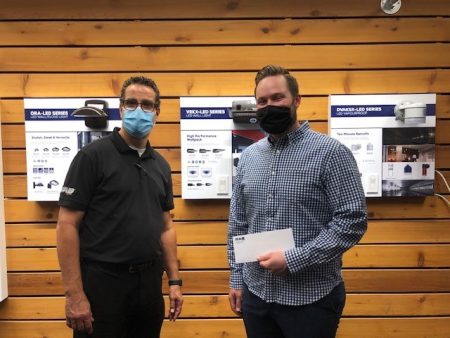
Toronto, September 13, 2023 – We are pleased to announce, Nikola Minor has been awarded the RAB Design Lighting Inc., Award of Excellence for the 2023 Electro-Federation Canada Scholarship program.
Nikola is in his fifth term of study in the Electrical Engineering Technology Co-op program at Niagara College in Welland, Ontario. Presently, he is working as an Electrical co-op student for E.S. Fox Ltd. in Stoney Creek, and plans on continuing his education and receiving his P.Eng. at Lakehead University, after graduating from Niagara College.
“I would like to thank the RAB Design Lighting team for having selected me as one of the 2023 Electro-Federation Canada Scholarship award winners. I am grateful for their generosity towards students, like myself, in the technology field. Their support will contribute positively to my ongoing learning and pursuit of a professional career.”
On behalf of the RAB Team, I would like to congratulate Nikola on this well-deserved scholarship and wish him much success in what is sure to be, a bright future,” said David Beron, President of RAB Design.
RAB Design Lighting is a Canadian owned and operated manufacturer of quality commercial and industrial lighting products. The Company has been servicing the electrical distribution market for more than 50 years. RAB Design is dedicated to bringing innovation in technology and energy efficiency to Canadians through our quality lighting products.
Toronto, October 14, 2022 – We are pleased to announce that Jesse Bertucci has been awarded the RAB Design Lighting Inc., Award of Excellence for the 2022 Electro-Federation Canada Scholarship program.
Jesse is currently in his second year of a four-year program at the University of Victoria. His course of study is Engineering: Electrical/Manufacturing. His ultimate dream is to become an electrical consulting engineer, in part, due to his passion for electrical lighting design, communications and technology systems.
Before entering university for engineering, Jesse worked full-time as a heavy-duty mechanic and part-time as a flight instructor. Before that, he was a soldier in the Canadian Forces reserves. After finishing his first-year of engineering, Jesse worked as an electrical designer (co-op) at AES Engineering in Victoria, BC. At AES Engineering, Jesse assisted with the lighting design for a new elementary school, a new secondary school, and a cafe.
“On behalf of the RAB team, I’d like to congratulate Jesse on this well-deserved scholarship and wish him much success in what we are certain will be a very bright future,” said David Beron, President of RAB Design.
RAB Design Lighting is a Canadian owned and operated manufacturer of quality commercial and industrial lighting products. The Company has been servicing the electrical distribution market for more than 50 years. RAB Design is dedicated to bringing innovation in technology and energy efficiency to Canadians through our quality lighting products.
Our third blog in the sports light series will outline the various applications in which these fixtures can be used. Although the name suggests that the lights are used for sports applications, there are actually a variety of uses for the lights. So, with that said, here are some instances where sports lighters could be the go-to.
Sports Applications
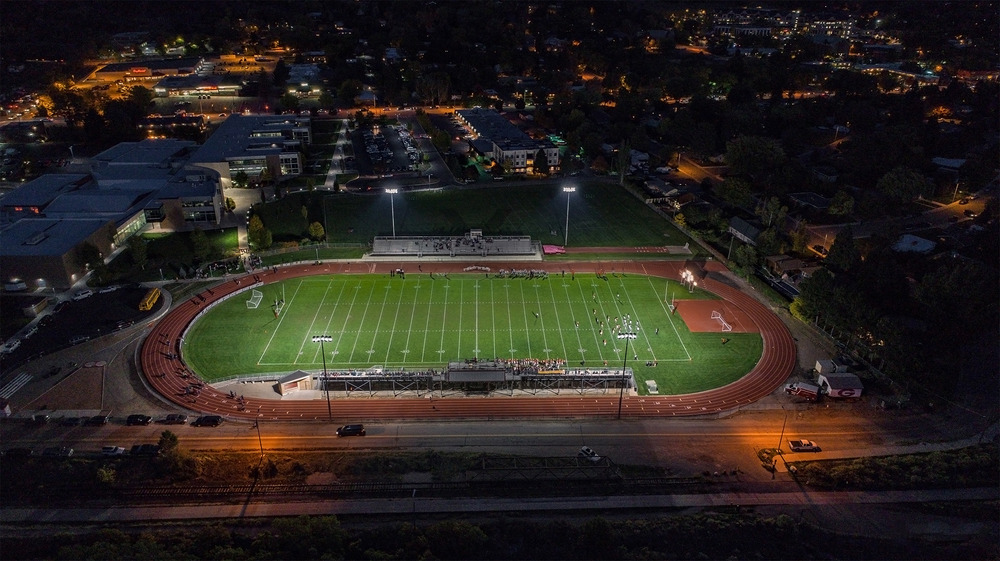
What: Starting out with the obvious is the various sports applications that use sports flood lights. Splitting this into two subcategories we have large and small sports applications. Examples of large applications can be soccer fields, football fields, and baseball diamonds. Examples of small applications are basketball courts, tennis courts, and hockey rinks. Although all the examples of large and small applications both have similar needs with regards to the lighting, there are some features which are appreciated more between the two categories.
Why Sports Lighters: Since sports lighters are typically designed with sports applications in mind, it is no surprise that a lot of the features are important for this application. That being said, this blog will highlight a feature that showcases the importance of the fixture for both large and small sports applications.
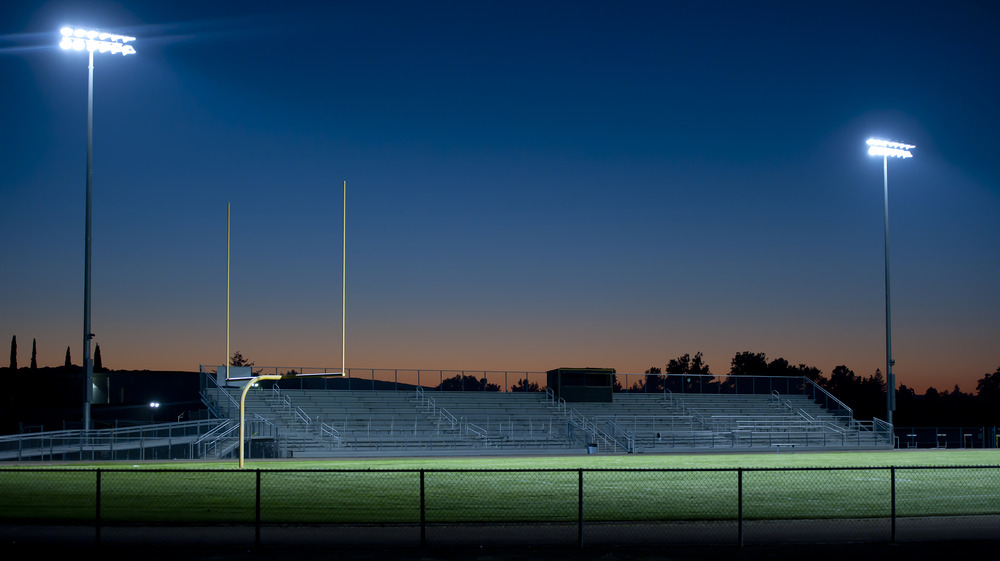
Looking at large sports applications, a sports flood light that is mounted at heights well over 100ft performing well is very important, as visibility on a field is a must have for both players and audiences alike. This is something that a sports lighter takes care of easily.
For smaller applications, the mounting height will be lower and so this might not be as important. However, with the light fixtures closer to the area of play, having the light angled correctly is very important to ensure the players are not blinded while using the facility. With a variety of angle and beam configurations, once again sports lighters are well equipped.
Outdoor Industrial Applications
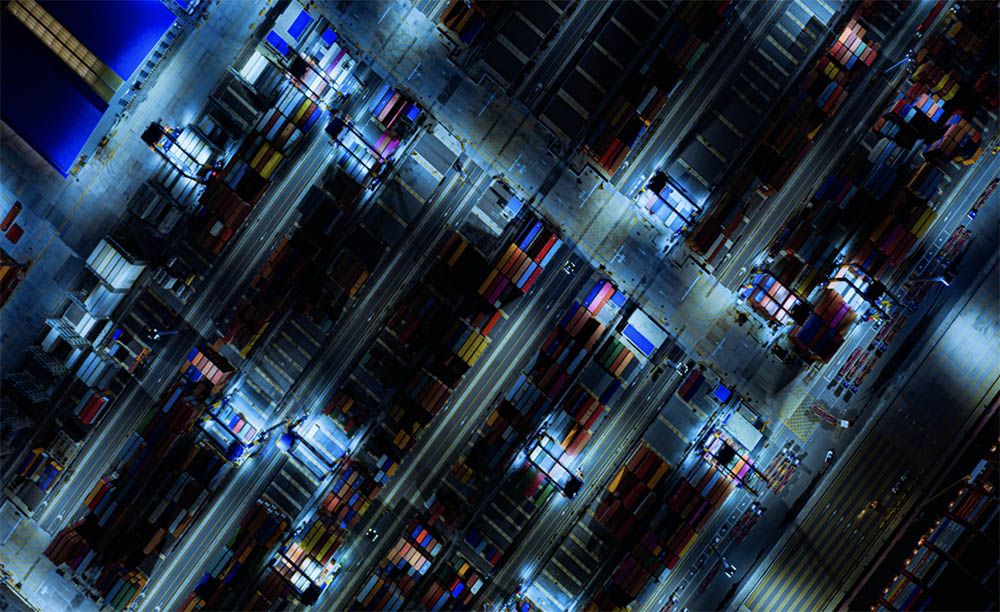
What: Outdoor industrial applications can mean a large range of things. This includes construction sites, loading docks, and ship/trainyards to name a few. Overall, the similarities between these applications are that they are outdoors and require a robust and effective light fixture that will work through tougher conditions.
Why Sports Lighters: So why would a sports lighter be an effective fixture for these applications? For starters, many of these examples would require a light fixture to be mounted at a large height and project light to a certain spot. Looking at a construction site as an example, a fixture may be mounted on a crane which would of course be high up as well as needing to illuminate an area bright enough for workers to see what they are doing. More than just needing to work at large distances, fixtures used in these applications need to be robust and not break easily. An LED sports light, such as the RAB SFL-LED, is designed so that even when mounted up high, things such as strong winds will not affect the fixture. For these reasons, sports lighters can actually be the perfect fixture for an outdoor industrial application.
Large Indoor Spaces
What: Like outdoor industrial applications, the application of a large indoor space can seem like a quite broad category. This application includes spaces such as airplane hangars or manufacturing plants. Essentially as the name states, just any large indoor space requiring high quality light.
Why Sports Lighters: As with the previous categories, one of the main factors that points to a sports light being the ideal fixture is the height at which the light needs to be mounted. Taking an airplane hangar as an example, the space needed to store a plane will by nature be quite large which in turn means that lights will have to be mounted at quite a large height. Beyond that however, another important feature of the sports lighter that makes it effective here is that there isn’t much maintenance needed. This means you are able to just put the fixture up and then not worry about it which is great as continually going up to a large height for maintenance can end up being a big pain, not to mention the potential risks to workers as well.
As you can see, many of the features a sports lighter has makes it ideal for a large variety of applications, apart from just lighting up the local football field. RAB’s SFL-LED has various mounting options available where outdoor industrial and sports applications can use either the slipfit or the yoke mount while indoor applications can use the highbay yoke mount.
If you want to learn more about this type of lighting check out the firsttwo blogs in the series. These blogs cover the differences between a sports flood and a general flood as well as some essential tips for facility managers with regards to LED sports lighting. You can find these blogs here.
Convinced that sports lighter might be ideal for your next project? Why not check out RAB Design’s SFL-LED as a great sports flood lighting option.
This is the second in a series of blogs covering sports flood lights. In this blog, we talk about key considerations for facilities management personnel when it comes to lighting their sports facilities. A Facility Manager has to think about many different things such as creating a great experience for the facility users, always keeping the lights on (literally and figuratively) and creating efficiencies for all of the different assets they manage (light fixtures being an important asset) in their facility. A large percentage of outdoor sports fields in Canada still use HID fixtures and often times it’s a choice between plowing through with HID fixtures and doing the cost-benefit analysis to make that switch to LED.
By comparing HID to LED sports lights in detail, you may be able to uncover some of the less obvious benefits to help you with your buying decision.
There are many benefits to using LED over HID in general and this blog covers some of them while using a sports flood as an example of how these benefits can be seen. Overall, an LED fixture will tend to have a much better lighting performance versus its HID counterpart. The benefits in a sports specific scenario are that the LED lighting benefits both the players on the field, court, or rink as well as the viewers who will have a much better time watching the game. Improved lighting performance may be a benefit that is more apparent when thinking about lighting, however there are many other aspects to think through. Let’s dive in.
Longer Lifetime
One of the biggest benefits of an LED fixture over an HID fixture is the significantly longer lifetime that the LED fixture provides. Along with the overall lifecycle of the fixture, an HID fixture tends to lose significant lumen output as it ages, and in the case of a sports flood, the brightness of the light is very important because of its application.
A longer lifecycle for the fixture means that the fixture runs at optimal performance and efficiency, with the least amount of maintenance requirements. Sports flood lights tend to be a significant capital expenditure so spending less money over the lifespan of the fixture is really important. Looking closer at the actual numbers behind the lifespan of the fixture we can see that while LED fixtures tend to last around 100,000 hours, an HID lamp will last somewhere between 10,000-25,000 hours. This means that on average you will need to replace 4-10 HID lamps to make up the amount of time of one LED fixture’s lifespan.
More Energy Efficient
When people think about LED vs HID one of the main factors of the discussion is how energy efficient LED lights are. This of course is the same when looking at the sports flood application. The main issue HID has with energy efficiency is that HID lights lose substantial energy to infrared (heat) emissions, whereas LED lights don’t have that problem. In case of sports floods RAB Design’s 500W SFL-LED fixture serves as an ideal replacement for a 750W Metal Halide fixture, and 600W SFL2-LED fixtures serve as an ideal replacement for a 1000W Metal Halide fixture.
Energy losses can occur in different ways. A form of energy loss is the rigid design of HID fixtures not allowing them to be directed in the correct direction. As covered in the first blog of the series, the angle and pattern in which sports flood lights are distributing light is crucial to the applications in which they are used. HID lights are omnidirectional, which means that energy is lost reflecting and redirecting the light to where it needs to go. LED lights are designed with engineered optics and emit light directionally, meaning there may be a need for fewer LED fixtures in comparison to HID fixtures. This redirection means that for an HID sports flood light can get trapped in the fixture which is of course energy wasted.
A final point to look at is how much power is actually being used in an HID fixture compared to an LED fixture of the same wattage. The rule of thumb is that the ballast of an HID fixture consumes an additional 10% of the total wattage. So, a 1000W Metal Halide fixtures has a total system wattage of 1100 Watts compared to 600W LED fixture.
Easier Maintenance
Aside from just the general lifespan of the fixture, there is a risk in HID sports lights that certain parts, such as the filament, will break with too much vibration. It is not uncommon for filaments to break in sports floods as they are installed high off the ground where wind can be a large factor creating vibrations. HID components such as lamps and ballasts, and HID fixtures themselves are getting harder to source with overall shrinking demand and global supply chain challenges. It can take months to repair HID fixtures at which point your season is hugely impacted. In a country like Canada where the use of sports floods is seasonal, any downtime repairing a fixture is a large portion of the active season. As an example, if we look at an outdoor hockey rink with a season of 4 months, a light being out of commission for 1 month is the equivalent of a quarter of the season or 3 months in a year.
The shorter lifetime of HID lamps along with the possibility of parts breaking means that it will need to be replaced a lot more frequently than its LED counterpart.
Safety
Along with just cost, another issue with needing to replace a sports flood fixture multiple times is safety. These fixtures can be on the top of a 100-foot pole which can be a risky operation for workers to undertake. Some of the materials in an HID fixture are also toxic which means that there is an added risk to installing as well as removing the fixture for the worker. LED sports flood lights don’t contain these toxic materials, they run cooler than HIDs, and also need to be replaced a lot less frequently meaning that risks to the safety of workers can be vastly reduced.
As LED fixtures tend to be smaller than HID fixture there is also an added benefit when it comes to transporting and installing the fixture as well in comparison to bulkier built HID fixtures that tend to be bigger as they require more space for ballasts and lamps.
As mentioned earlier, continually having to replace and conduct maintenance activities on the asset will be more costly in the long run. LED fixtures such as the RAB Design’s SFL-LED Series, give the Facility Manager peace of mind thanks to limited maintenance and maximum uptime for various assets and facilities.
If you’re unsure if it’s time to make that switch from HID to LED, we have a checklist that should help you decide. Click here to access the checklist.
Stay tuned for the 3rd and final installment of this series or check out the first blog here if you haven’t already!
Outdoor sports lighting can be a complex field with many different variables and considerations. In this blog series, we will distill some of the key ideas to help you decide if it is right for your sports field.
This is the first of a series of blogs covering sports flood lights. Sports lighting is used for baseball, football, soccer, tennis courts, hockey rinks, and more. This blog outlines some of the major differences when comparing a sports flood light to a regular flood light. Beyond the obvious fact that a sports lighter is a specialty fixture intended for outdoor sports fields, regular floods are often used as the lower cost option.
There are several things to consider when thinking about the right fixture to use at your facility/field, the most important one being light level requirements. Light level requirements can vary depending on the classification of the field, the level of competition, the users of the facility, existing light levels, and existing light sources being used. For example, in a university football field, prescribed light levels as recommended by the IES Handbook are from 200 lux/20 footcandles to 1000 lux/100 footcandles on the horizontal and 50 lux/5 footcandles to 300 lux/30 footcandles. A lighting layout comparing light levels from a sports lighter to a regular flood will provide an indication of the difference in light levels and uniformity of light spread. Reach out to lightingdesigns@rabdesign.ca to get a conversation started on a custom layout design for your facility/field.
Moving on, we will now look at some of the key differences between a general flood light and a sports flood light.
Higher Lumen Output
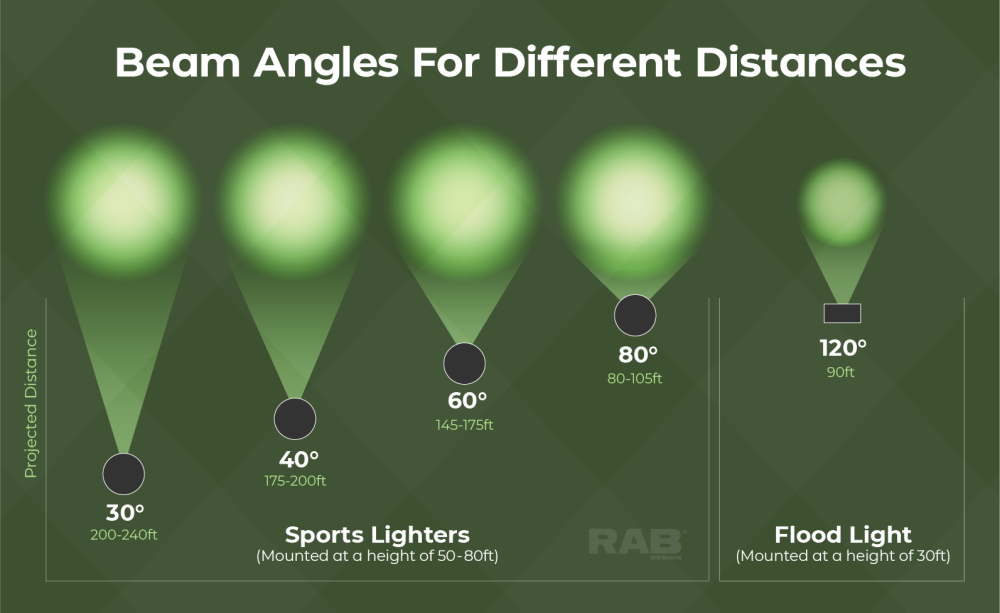
One big difference is that sports flood lights tend to be the higher end option. Sports flood lights generally deliver higher lumens, sometimes over 100,000 lumens. A big benefit of the higher lumens is that the sports flood lights can be mounted at larger distances and heights. These lights need to be able to perform, even if they are 100 feet in the air, for example if they are mounted on a pole overlooking a football field. Sports lighting is designed to project a beam of light out a certain distance and from a certain mounting height (See chart 1 below). Flood lighting on the other hand is designed to illuminate at a shorter distance out from the pole or mounting location.
General purpose floods usually go up to about 60,000 lumens and are ideal for mounting heights of 20 to 40 feet. As stated earlier, this means for mounting heights greater, specialty sports floods provide a significantly higher lumen output.
Higher lumen output is derived through higher wattage or more power being consumed by the fixture. A good metric when comparing fixtures is efficacy or lumens per watt or LPW. RAB Design’s sports light has an efficacy of 150 lumens per watt. It is DLC 5.1 Premium which is key to securing rebates, depending on your region.
Different Beam Patterns and Options
Sports flood lights will typically have more options for beam patterns compared to regular floods as sports floods need to have a much larger variety of patterns and angles to fit how they are being used. The narrow beams are needed to project the light out a greater distance, 200 to 240 feet, the 60 degree angle reaches 145 feet to 175 feet and the 80 degree beam would be under 105 feet (see chart 1). In a way a sports flood light is really more like a spotlight that is projecting light out to a certain spot while a general purpose flood light is just looking to spread the light out.
A clear example of why the angle of the beam pattern is so important for a sports flood compared to a regular flood can be seen in the example of lighting up a baseball diamond. For areas that need greater amounts of light, you need a better control of that beam of light. In this example, on a baseball diamond the outfield poles would require a narrow beam of light 20 degrees to illuminated from the bases back towards the poles along with a wide 80 degree beam to illuminate out to 80 feet from the pole.
Let’s say there’s a pop fly and the outfielder is looking upwards to catch the ball, the last thing you want is for the player to be blinded by the light. Being able to configure the beam to shine at an angle that avoids this problem is key for sports floods.
Weight & Footprint
Sports lights have a larger footprint and weigh more compared to regular floods. This is an important consideration for Installers
If you found this blog useful, blog stay tuned for the next blog covering sports flood lights coming out soon!
Exterior lighting is an essential part of every school grounds. If done right, it provides the students, staff, and surrounding neighbors with safety, security, and peace of mind.
With the arrival of LED technology and lighting controls, exterior lighting can also provide energy and cost savings.
When choosing luminaires for an exterior lighting project, there are many important variables to consider. To help you out we have listed three important exterior lighting factors for three levels of schooling: Elementary & Middle schools, High schools, and University Campuses.
Elementary & Middle Schools
In terms of square footage, elementary and middle schools have the smallest school grounds. They are often in residential neighborhoods and require special considerations.
Glare
Glare is an important safety issue for schools. Glare can be distracting to drivers and may even temporarily blind them. Exterior lighting around a school should limit glare for the safety of students and residents.
When choosing luminaires, you will want to check its BUG rating. The lower the better it is at directing light where it is supposed to go.
Durability
A tough luminaire can absorb the impact of playground ball games and harsh weather conditions.
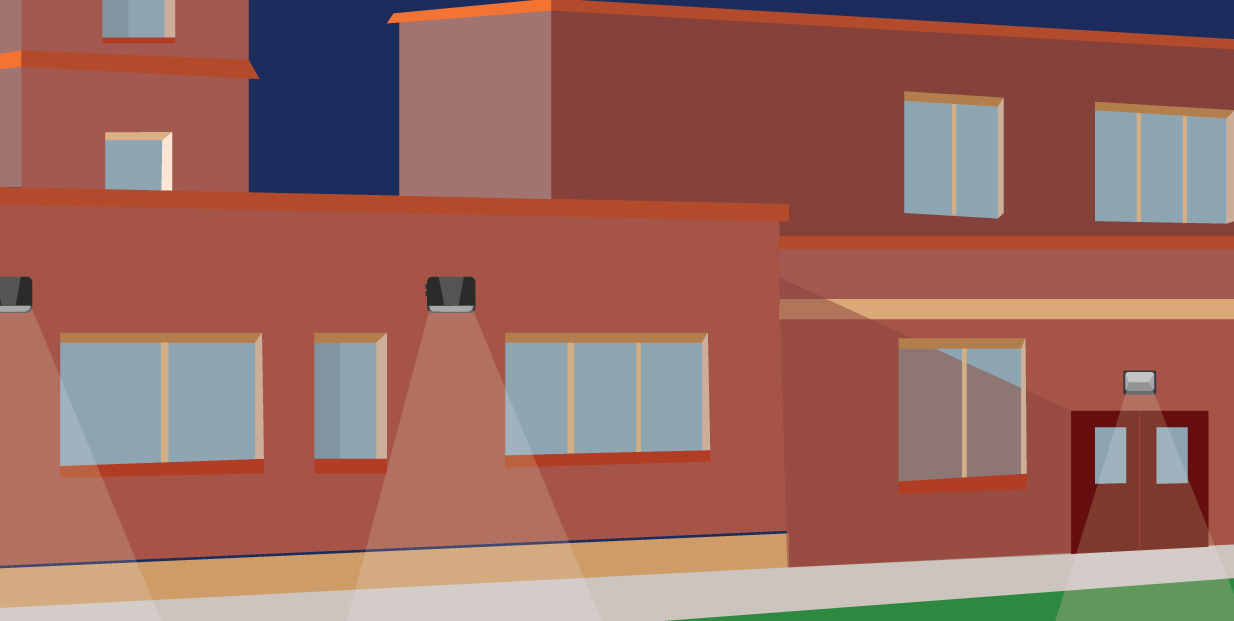
We recommend wall packs with a polycarbonate lens and die-cast aluminum housing. Accessories, such as a wire guard, can also improve the durability of a luminaire.
Elementary and Middle Schools are common in residential neighborhoods where light trespass is an important consideration. Residents should be comfortable in their homes without unwanted light trespass.
Look for full-cutoff luminaires or consider adding a cut-off shield accessory to your install.
The luminaire’s BUG rating is another indicator of how good the fixture is at directing light where needed. Generally, the lower the BUG rating the better the luminaire is at directing light.
High Schools
Like elementary and middle schools, high schools are also commonly found in residential areas, but with a much larger campus size.
Security
Security is more important for high schools due to higher rates of vandalism. A motion sensor-enabled luminaire works in tandem with security cameras to identify potential vandals.
Motion sensors can also help reduce unwanted light trespass from security flood lights and provide energy savings when motion is not detected.
Energy Savings
A bigger campus size means more luminaires are needed to cover perimeter lighting, multiple entrances, and parking lots. This is where lighting controls can provide big energy savings by dimming or turning off lights during off-hours.
We also recommend switching to LED luminaires for even more energy savings.
Dark Sky Compliance
Having dark sky compliant luminaires helps the residents and wildlife by reducing harmful light pollution.
Blue light is a big contributor to light pollution, try to use warm color temperatures in your install. Full-cutoff luminaires and cut-off shield accessories also help direct light only where it’s needed to reduce light pollution.
University & College Campuses
Large sprawling campuses with different exterior lighting needs. It’s hard to pinpoint just three exterior lighting factors because of the many different types of exteriors on campus (E.g., residential dorms, lecture buildings, parking structures, pathways, sports facilities, statues, etc.). We’re going to focus on the broad lighting best practices for a large University or College campus.
Safety and Security
Exterior lighting is vital to night-time safety and security on campus. Pathways, entrances, and emergency phones should be well lit to provide students and faculty with a sense of security.
Lighting Controls
Simple lighting controls such as timers and occupancy sensors can provide big energy savings for a large campus. Many rebate programs also have a controls element, be sure to check your local rebate program to see which controls are eligible.
Consistent CCT
A college campus will require many different luminaires, make sure you keep a consistent CCT for all of your exterior installs on campus. A consistent CCT improves the overall look on campus and makes it more comfortable for students and faculty.
Pictured above RAB Design President, David Beron presenting David Gilmer with the 2021 RAB Design Award of Excellence.
Toronto, October 1, 2021
We are pleased to announce that Charles Gilmer has been awarded the RAB Design Lighting Inc., Award of Excellence for the 2021 Electro-Federation Canada Scholarship program.
Charles is currently in his second year of a four-year program as an Electrical Engineering Technology – Control Systems student at Humber College. He recently began a co-op position with the City of Brampton’s Public Works and Engineering department, working with the Street Light Team. It has sparked his interest in electrical infrastructure management and traffic signal control, which he plans to pursue further.
“I have learned that I thrive and contribute best when I have opportunities for continuous learning, applying technical knowledge, troubleshooting, and developing creative solutions. I have spoken to friends and peers working in electrical roles, and their guidance affirmed that a career in electrical engineering technology will offer these types of opportunities. I am so grateful to the RAB Team for selecting me as the recipient of this generous scholarship. It is wonderful and motivating to have the RAB Team believing in me, and I am excited to work hard and learn as much as I can. Thank you RAB Design Lighting!” said Charles.
Charles is a soon to be father and in his spare time, he enjoys engine repair and maintenance, woodworking, playing guitar and giving back to the community by volunteering.
“On behalf of the RAB team, I’d like to congratulate Charles on this well-deserved scholarship and wish him unlimited success in what we are certain will be a very bright future,” said David Beron, President of RAB Design.
RAB Design Lighting is a Canadian owned and operated manufacturer of quality commercial and industrial lighting products. The Company has been servicing the electrical distribution market for more than 50 years. RAB Design is dedicated to bringing innovation in technology and energy efficiency to Canadians through our quality lighting products.
Are LED Lights Considered Good for the Environment?
Yes, LED lights are better for the environment than traditional light sources as with proper heat management they can last much longer. LEDs deliver the same amount of lumens as traditional luminaires, but with less energy consumption. For example, a 400W HID luminaire can typically be replaced by a 150W LED luminaire and still deliver the same lumens.
Efficiency
Do LED Lights Burn Out?
Yes, all light sources will eventually burn out. However, LED sources typically last much longer than traditional light sources. They usually have a longer L70 rating. For example, a quality LED luminaire will have at least an L70 rating of 50,000 hours, while an HID luminaire may only have a rating between 6,000 to 15,000 hours.
Do LED Light Bulbs Save Money?
Yes, LED lights save money on energy consumption. They produce a higher rate of lumens per watt, meaning they are much more efficient and use less energy to produce the same amount of light.
L70 is a means of measuring lumen maintenance. The L70 refers to the point when an LED lamp source is producing 70% of its initial lumen output. For example, the RAB NTH-LED20 initial lumen output is 2089, its L70 rating is 100,000 hours. So at 100,000 hours the luminaire will be producing roughly 1462 lumens.
Why is this rating important when considering a luminaire?
This rating allows you to know how long you can depend on a luminaire to produce an acceptable amount of light.
Concerns
Do LED Lights Produce Heat?
The short answer is yes, LED luminaires produce heat. The long answer is that while LED diodes produce heat, it isn’t where you might think. The heat is generated at the back of the LED chip. So, the back of the diode gets really hot, but the front/exterior of the luminaire remains cool to the touch.
In order to obtain long life, it is crucial to manage the internal temperature (junction temperature) of LED diodes. This can be accomplished in a variety of methods, one of the most common being the implementation of heatsinks to pull the heat away from the LED diode and disperse it.
Ideally, the best light for your eyes is that of natural light, which would be around 5000K and higher. Natural light boosts your vitamin D and has a tremendous effect on your circadian rhythm. In the absence of natural light, it is best to design the light to the needs of the space. For example, in an environment such as a doctor’s office or surgical room you would install a luminaire with 5000K or higher CCT for bright blue-white light – something crisp and clean. On the other hand, In a recovery room, you may want to step down to something 3000K to 2700K, that is more calming and cozy.
What luminaire is the right luminaire for my application?
This is all relative. In order to figure out the right luminaire for the application you have to consider the following:
Budget – What is the budget for this application?
Rebates – Are there rebates available to offset the cost of the initial purchase of materials and labor?
Time – How soon is the project going to start? When does it need to be completed?
Usage – What is the usage of the given space? Is it a manufacturing plant, a supermarket, an office space? If work is being conducted, what type of work, is it a machinist shop where detailed work is being done or is it a warehouse?
Demographic – What is the average age of the people occupying the space? Is an older demographic that will need more light, brighter light? Is it a young demographic that will not need as much light and would benefit from a warmer color temperature?
In some applications, more than one luminaire might be needed to properly illuminate space.
Key Benefits
Are LED Lights Dimmable?
Yes, LED luminaires can be dimmed provided that:
The driver controlling the LED is a dimmable driver.
You use the right dimmer.
For example, some LED luminaires have a 0-10V dimming driver which would require a 0-10V dimmer. Others work off of ELV (Electronic Low Voltage), in this application you would use an ELV dimmer.
You size the dimmer to the application. LED luminaires have a much larger inrush current (amount of power it takes to turn something on) than traditional light sources. In order to compensate for that initial inrush current, you have to upsize your dimmer.
Can I use LED lights outdoors?
Yes, LED luminaires can be used in outdoor application ratings provided they have the appropriate IP or UL rating. For outdoor applications, the appropriate IP rating could be anything from IP44 to IP68. IP65 rating should cover most outdoor applications. When using UL as a guideline for outdoor use, look for a damp (think lighting under canopies, soffits, etc.) or wet location rating. When in doubt, contact a professional for help selecting the right luminaire for the job.
Should I change my light bulbs to LED?
Yes, the benefits to switching to LED from traditional light sources have been addressed ad nauseam over the past 15 years. LEDs are more environmentally friendly, and typically have a longer lifespan than traditional light sources. They also save on energy and labour costs, and are easier to control than some traditional light sources, like HIDs.
DLC certification is a utility based initiative and one of the most important lighting certifications that customers look for. Many organizations offer rebate programs based on meeting DLC standards on a variety of luminaires such as but not limited to wall light, flood light, ceiling panels and high bays. DLC certifications require you to comply with 3 main aspects to the lighting which are distribution, color and longevity. These aspects must be tested by an accredited laboratory to be DLC certified. Testing results are submitted directly to the DLC by the manufacturer.
Notable RAB products with DLC Premium lighting certification would be LFX8-LED, HELIX-LED, WP-LED and many more!
UL Certification
UL stands for Underwriters Laboratories, UL standards are employed throughout many industries to assure specific product performance and safety. If a luminaire has a UL marking along with a control number, it means it has met all safety requirements for that specific environment. There are 3 main UL markings, dry locations, damp locations and wet locations. Products with dry locations certification are typically used indoors and above-ground rooms, such as bedrooms, kitchens, offices, retail stores. It is the most common certification amongst lighting and it is also known as UL Listed within the industry.
Damp Locations Rated
Damp locations certification is approved for lightings that are regularly exposed to moisture and condensation. However, it is important to note that your luminaire can only handle a limited amount of water exposure which means that it cannot be directly exposed to snow or rain. Main applications for this marking would be outdoor usage with some coverings such as patio or perimeter of stores.
Wet Locations Rated
Wet locations rating means that the fixture can essentially be installed anywhere and has minimal limitations dealing with liquid as this rating allows the luminaire to come in direct contact with most types of liquids. If the product is UL listed, it indicates that the product has been tested to meet the safety standards of the United States by Underwriters Laboratories. While cULus indicates that the product has been tested to meet the safety standards of Canada and the United States by Underwriters Laboratories.
ETL
Similar to UL, An ETL certification means that products have been tested to set safety standards. ETL has 24 different marks/certifications to indicate anything from safety to health and environmental benefits.
A product bearing the ETL Listed mark with the “us” identifier at the 4 o’clock position has been tested and deemed compliant to U.S. product safety standards only. An ETL Listed mark with a “c” identifier at the 8 o’clock position means the product bearing it complies with Canadian product safety standards only. And an ETL Listed mark with both “us” and “c” identifiers at the 4 o’clock and 8 o’clock positions respectively, signifies that the product bearing the mark complies with both U.S. and Canadian product safety standards.
UL and Intertek (parent organization of ETL) are some of the few NRTLs (Nationally Recognized Testing Laboratories), a third-party testing program overseen by the Occupational Safety and Health Administration. Main difference between UL and ETL is that ETL does not publish their own standards. Instead, they test components to established standards of other NRTLs such as UL, ASME and ASTM.
IP
IP known as Ingress Protection defines the level of protection for the luminaire against outside bodies like debris, dirt and different forms of liquid. The numbers that follow IP each have a specific meaning. The first number represents the degree of protection from moving parts, as well as the protection of enclosed equipment from foreign bodies. The second number indicates the protection level that the enclosure enjoys from various forms of moisture.
There are 4 common IP certifications amongst lighting, IP65, IP66, IP67 and IP68. IP65 suggests that the luminaire is “dust tight” and protected against water projected from a nozzle. IP66 indicates that it is “dust tight” and protected against heavy seas or powerful jets of water. IP67 highlights that it is “dust tight” and protected against immersion of water for 30 minutes at depths of 150mm – 1000mm. Lastly, IP68 is rated as “dust tight” and protected against continuous submersion in water.
Hazardous Locations (UL884)
It is locations where explosion or fire hazards exist due to the presence of flammable gases, flammable or combustible liquid-produced vapors, combustible dusts, or ignitable fibers. Hazardous Locations are classified by the likelihood of an ignitable concentration of combustible material being present. There are two systems in place, including the traditional North American Division system as well as the alternative Zone system.
UL844, explosion proof lighting for Hazardous Locations–is one of several lighting certifications used in conjunction with National Electrical Code Classes, Divisions, and Groups of atmospheres for the selection of fixtures for normally and not normally hazardous locations where volatile flammable liquids, flammable gases, and combustible materials may be present in the atmosphere. Common examples of hazardous locations that require luminaire would be sawmills, grain silos or waste water treatment plants.
NEMA stands for National Electrical Manufacturer Association. NEMA ratings are standards to justify the environment that the electrical fixture can be used in and are mainly applied to fixed electrical enclosures. There are many NEMA ratings for different circumstances but the one we employ for our luminaires would be NEMA 4X. NEMA 4X highlights that the luminarie is suitable for Indoor or outdoor use primarily to provide a degree of protection against corrosion, windblown dust and rain, splashing water, hose-directed water, and damage from external ice formation.
Shoutout to Ed Wynne of RAB Design for his expertise throughout the blog!